
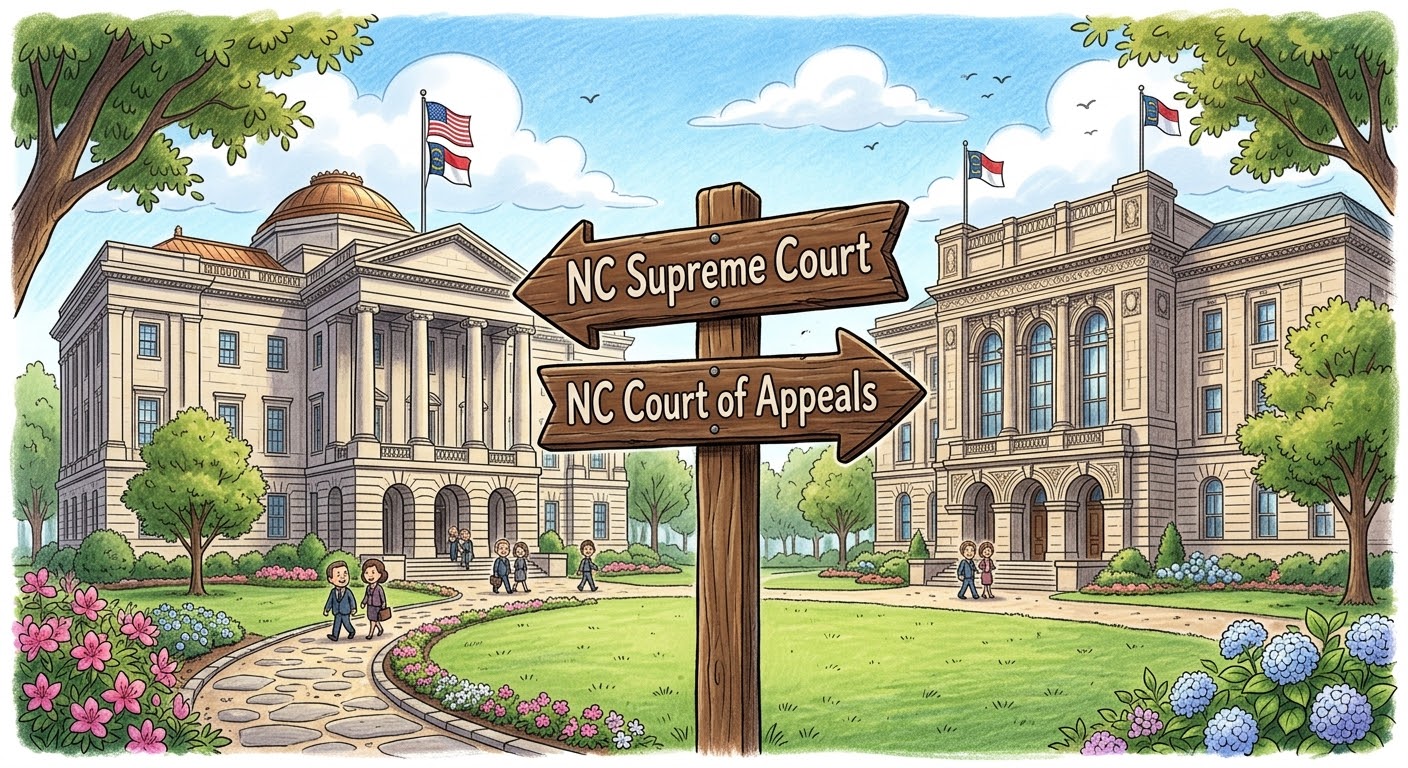
While the best bet on a prediction market like Kalshi might be that trial results are just unpredictable, one thing that seems relatively certain about practice before the Business Court is the appeal path that follows. By statute the Court’s final judgments, and the appealable interlocutory orders of the Court’s judges, head to the North Carolina Supreme Court as of right.
But maybe not always, it turns out. In Joint Entities, LLC v. Cobham, COA25-858, recently decided by the Court of Appeals, that court retained jurisdiction over appeal of a judgment by Business Court Judge Houston that imposed interest and court costs on the defendant arising from a previously unsatisfied judgment entered in the Business Court. The key, it turns out, was which hat the judge was wearing when the decisions were rendered.
Two dentists who had co-managed multiple dental practices had a falling out and engaged in litigation that centered on allegations of self-dealing, conflicts of interest, and breached fiduciary duties. A bench trial in the Business Court before Judge Houston resulted in a judgment exceeding $2 million against defendant Sharon Cobham that was not satisfied. Cobham filed for bankruptcy, the bankruptcy court found her debt not dischargeable, and the Eastern District and Fourth Circuit affirmed. Id. at 2-3.
With that lengthy federal path exhausted, the plaintiff still had an unsatisfied judgment and then filed a new action in state court upon a judgment debt under N.C.G.S. § 1-47 asking the trial court to renew the prior judgments and impose nearly $2 million in interest and court costs. Id. Cobham was served but did not respond, and Judge Houston entered a default judgment. A writ of execution was returned by the sheriff unserved. The order before the Court of Appeals was entered by Judge Houston in aid of execution, requiring direct payments and ordering restrictions on Cobham’s expenditures. Joint Entities, at 3-4.
The statute at issue, N.C.G.S. § 7A-27(a), affords two relevant paths to the NC Supreme Court:
- Under (a)(2) for “any judgment in a case designated as a mandatory complex business case” or as “a discretionary complex business case pursuant to Rule 2.1”; and
- Under (a)(3) for “any interlocutory order of a Business Court Judge” that affects a substantial right, effectively determines an action but prevents appeal, discontinues an action, or grants or refuses a new trial.
Judge Griffin’s opinion in Joint Entities affirms jurisdiction for the Court of Appeals under subsection (b)(3), which provides the COA jurisdiction for “any interlocutory order or judgment of a superior court or district court in a civil action or proceeding[.]” The interpretative space to claim jurisdiction came because the order on appeal from Judge Houston did not arise from a case designated to the Court under (a)(3), but instead from a closely related follow-on action that Judge Houston ostensibly handled because he had issued the underlying judgment. Joint Entities, at 6.
The Court of Appeals noted that the “plain language” of § 7A-27 “leaves wiggle room for this order to have been brought directly to the Supreme Court of North Carolina” – presumably because it’s an “interlocutory order of a Business Court Judge” under (a)(3). But the court “nevertheless” found it could review the order because Judge Houston was “a business court judge as well as a special superior court judge,” and thus “it also falls under section 7A-27(b)(3), an appeal from an interlocutory order of a superior court in a civil action.” Id.
Worth Noting
- While the jurisdictional “wiggle” present in Joint Entities might not often repeat, it does commend attention to the filing of follow-ons to prior Business Court actions and the importance of seeking repeat designation to the Court to ensure a Supreme Court appeal path – if that’s desired.
Brad Risinger is a partner in the Raleigh office of Fox Rothschild LLP.